
Bass Chord Sheet
On bass you usually play chords one note at a time as arpeggios, or as two-note double stops. Pick a root and chord type to see every chord tone on the first twelve frets of a 4-string bass, a compact one-position shape to learn, and the note names — then play it to hear the arpeggio.
- Free to use
- No sign-up
- Runs in your browser
Bass chord and arpeggio finder
Bass Chord Sheets
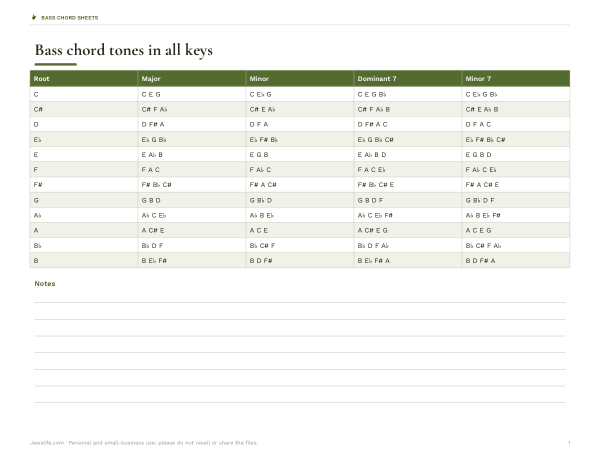
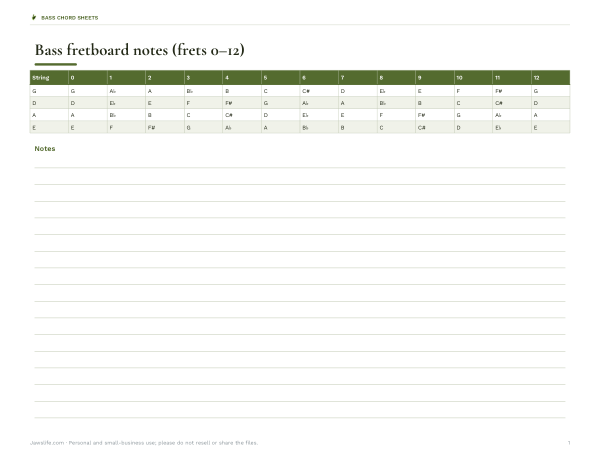
Printable bass chord sheets: arpeggio shapes (major, minor, 7th) for all 12 keys, blank 4-string fretboard diagrams, a fretboard note map and a groove practice log.
- Chord tones (PDF/XLSX)
- Fretboard map (PDF)
- Blank fretboards (PDF)
- Practice log (PDF, XLSX)
Formats: PDF, XLSX. Instant download after payment (link valid 72 hours, up to 5 downloads). AI-assisted: the templates were drafted with AI help and reviewed and laid out before publishing.
$3.00 USD, one-time 4 files · about $0.75 each
- Instant download
- 7-day refund
- Secure checkout by Stripe
7-day money-back guarantee. Full refund within 7 days of purchase, even after you download.
Free sample: Bass Chord Tones All Keys (PDF, 66 KB)
Full refund within 7 days — see the refund policy and license.
Free printables
Single sheets you can print right now, no sign-up. The full pack adds every sheet in one download plus the editable files.
 Printable Bass Practice Log
Chord formulas for bass
| Chord | Formula | Example in A |
|---|---|---|
| Power chord | R – 5 – 8 | A – E – A |
| Major | R – 3 – 5 | A – C# – E |
| Minor | R – ♭3 – 5 | A – C – E |
| Dominant 7 | R – 3 – 5 – ♭7 | A – C# – E – G |
| Minor 7 | R – ♭3 – 5 – ♭7 | A – C – E – G |
| Major 7 | R – 3 – 5 – 7 | A – C# – E – G# |
| Diminished | R – ♭3 – ♭5 | A – C – E♭ |
Bass players outline chords by playing these notes in patterns, most often root and fifth, adding the third to say whether the chord is major or minor.
Moveable shapes
| Chord | Shape from the root (string: fret offset) |
|---|---|
| Root–5th | Root; next string +2 frets |
| Root–octave | Root; two strings up +2 frets |
| Major triad | Root; next string −1 (3rd) and +2 (5th) |
| Minor triad | Root; same string +3 (♭3); next string +2 (5th) |
| Dominant 7 | Major triad + two strings up, 0 frets (♭7) |
| Minor 7 | Minor triad + two strings up, 0 frets (♭7) |
Because a 4-string bass is tuned in fourths (E–A–D–G), every shape is the same on any string set and in any key — move it up or down the neck to change key.
How to use the finder
- Choose a root note and chord type.
- The fretboard shows every chord tone from the open strings to the 12th fret; the root is red.
- Outlined dots show a compact one-position shape to learn first.
- Press play to hear the arpeggio up and down.
- Print the chord sheet to practise away from the screen.
Worked example
For an A major chord, the finder shows A (root) at the 5th fret of the E string, C# at the 4th fret of the A string and E at the 7th fret of the A string — the classic major shape. Adding G at the 5th fret of the D string gives A7. Play R–5–8 (A–E–A) for a rock groove or R–3–5–3 for a walking feel.
Double stops and bass “chords”
Full chords sound muddy in the bass register, so bassists usually play single notes or two-note double stops. Good choices are the root and fifth, the root and a tenth (the third an octave up, played across two strings), or the third and seventh higher up the neck. Keep double stops above about the 5th fret for clarity.
Using arpeggios in bass lines
- Start on the root on beat one of each chord change.
- Use the 5th and octave to fill space without clashing.
- Add the 3rd to define major or minor, especially in ballads.
- Approach the next chord’s root by a step (a “passing note”).
- Walking bass lines in jazz use chord tones on strong beats.
Common progressions to practise
| Progression | Chords (key) | Try |
|---|---|---|
| I–IV–V | A – D – E (A major) | Root–5th–octave on each chord |
| I–vi–IV–V | C – Am – F – G (C major) | Major and minor triads |
| 12-bar blues | A7 – D7 – E7 | Dominant 7 arpeggios, walking up and down |
| ii–V–I | Dm7 – G7 – Cmaj7 | Seventh-chord arpeggios, jazz style |
| Minor i–VI–VII | Am – F – G | Minor triads and roots |
Play each chord’s arpeggio for one bar, then try connecting chords by moving to the nearest chord tone rather than always jumping to the root.
Fingering tips
- Use one finger per fret in a four-fret position.
- Keep the thumb behind the neck, roughly opposite the middle finger.
- Mute unused strings with the fretting hand and the plucking hand.
- Alternate index and middle fingers when plucking.
- Practise arpeggios slowly with a metronome, then speed up.
Reading the fretboard diagram
The diagram shows the neck horizontally with the lowest string (E) at the bottom, as if you were looking down at the bass on your lap. Fret numbers run along the bottom. Each dot carries its chord degree — R for root, 3 or ♭3 for the third, 5 for the fifth and 7 or ♭7 for the seventh — so you can see how the same chord tones repeat across strings and positions.
5-string and 6-string basses
Extended-range basses add a low B string (and sometimes a high C). The shapes are identical because the tuning stays in fourths — you simply gain more positions. The finder shows standard 4-string tuning; on a 5-string, the same patterns start one string lower.
What the printable pack includes
Printable bass chord sheets for all 12 keys (major, minor and 7th arpeggio shapes), blank bass fretboard diagrams, a root-note fretboard map and a groove practice log.
Frequently asked questions
Can you play chords on bass?
Yes, usually as arpeggios or two-note double stops rather than full strummed chords.
What notes make an A major chord?
A, C# and E.
What is a power chord on bass?
Root, fifth and octave — for example A, E and A.
What is the formula for a minor 7 chord?
Root, flat 3rd, 5th and flat 7th.
Do shapes change between keys?
No, on a bass tuned in fourths the shapes are moveable.
What is the difference between a chord and an arpeggio?
A chord is notes played together; an arpeggio plays the same notes one at a time.
Which notes should a beginner bassist play?
Start with roots, then add fifths and octaves.
Why is the third important?
It tells the listener whether the chord is major or minor.
Can I use the chart for a 5-string bass?
Yes — the shapes are the same; the extra low B string gives more positions.
What does the red dot mean?
It marks the root note of the chord.
Is anything uploaded?
No, it runs in your browser.